

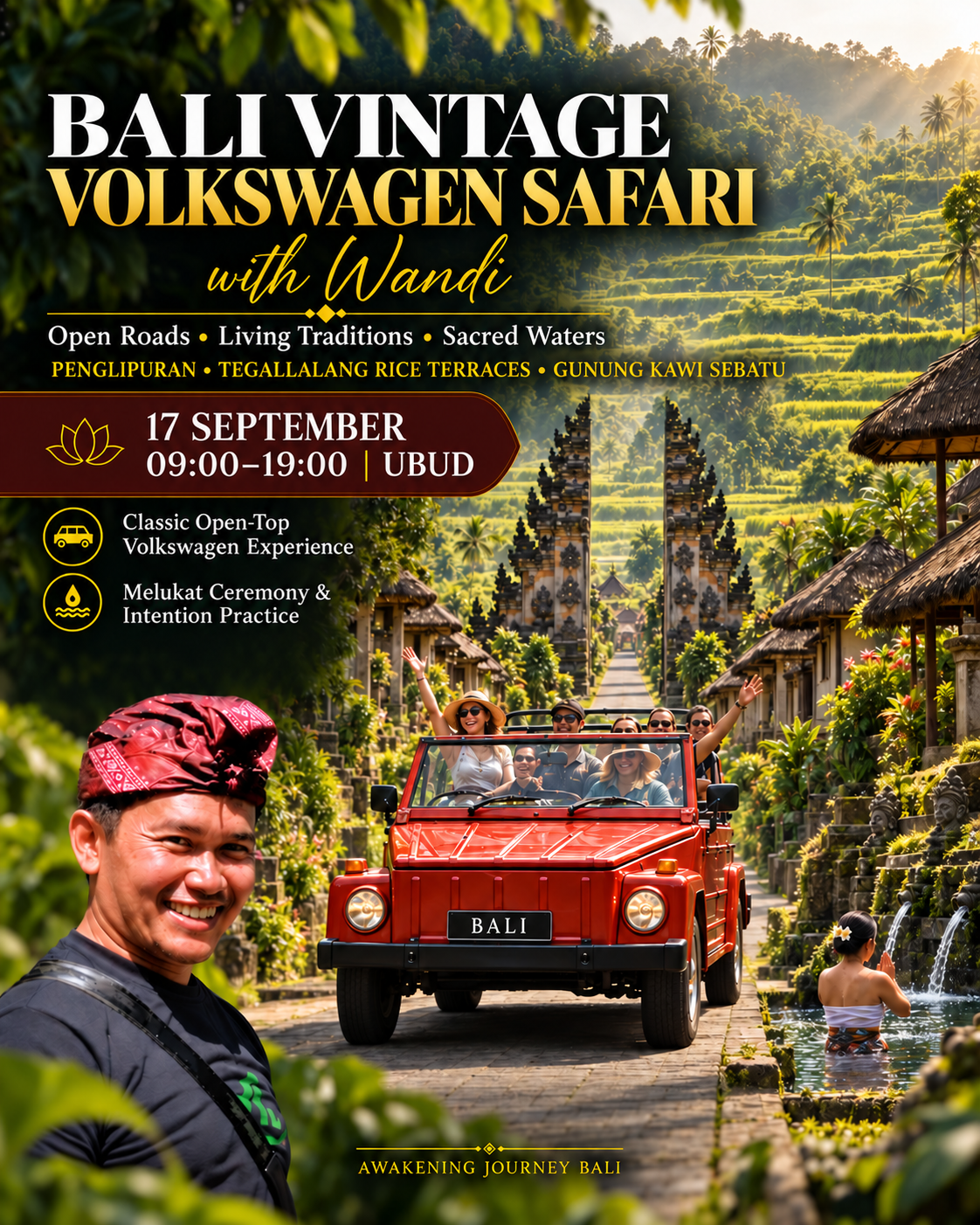
Bali Open-Top Volkswagen Safari & Living Traditions Tour
$85.00
13 in stock
🗓️ Date: 17th September – Thursday
📍 Locations: Penglipuran Village • Bamboo Forest • Tegallalang Rice Terraces • TIS Café • Gunung Kawi Sebatu
✨ Theme: Freedom • Culture • Intention • Purification • Renewal
✅ Included: Local Guide • VW Safari Transportation • Entrance Fees • Melukat Ceremony • Traditional Offerings
👥 Maximum 14 Participants
Daily Tour Details
Experience Bali from the open top of a classic Volkswagen as we travel through scenic roads, traditional villages and iconic rice terraces. Step inside local family compounds in Penglipuran, walk through its ancestral bamboo forest and enjoy the famous Tegallalang view from TIS Café. The journey concludes at Gunung Kawi Sebatu with intention work and a traditional Melukat ceremony to cleanse the mind, body and spirit.
🌬️ Classic Open-Top Volkswagen Safari
🏡 Penglipuran Traditional Village
👨👩👧👦 Visit Local Balinese Family Compounds
🎋 Penglipuran Ancestral Bamboo Forest
🌾 Tegallalang Rice Terrace Experience
🍽️ Panoramic Lunch Stop at TIS Café
🛕 Gunung Kawi Sebatu Temple
🙏 Traditional Melukat Purification Ceremony
✨ Intention, Cleansing & Renewal Practice
📸 Photography and Video During the Ceremony
🧭 Guided by Our Local and Spiritual Guide, Wandi
🎟️ Volkswagen Transportation, Entrance Fees and Offerings Included
ℹ️ Lunch and Drinks Are Not Included
Open Roads, Living Traditions & Sacred Waters with Wandi
About the Journey
This is not an ordinary day tour. It is an open-top Volkswagen adventure through the heart of Bali—combining unforgettable roads, authentic village life, iconic rice terraces and a meaningful sacred-water experience.
Some journeys are not only about where you go, but also about how you experience the road. This special day has been created to bring together freedom, adventure, authentic cultural connection and spiritual renewal—revealing Bali through its landscapes, traditions and sacred waters.
The heart of the experience is the journey itself. Travelling in colourful, classic open-top Volkswagen vehicles, we will leave Ubud behind and follow scenic roads through traditional villages, rice fields, coconut trees and tropical landscapes. With the roof open, music playing and the island unfolding around us, every part of the route becomes an opportunity to feel the freedom, beauty and joyful spirit of Bali.
Our most important cultural destination will be Penglipuran, internationally celebrated as one of the cleanest, most beautiful and orderly traditional villages in the world. Beyond its picture-perfect central street lies a living community that has preserved its ancestral architecture, environmental values, family structure and cultural identity across generations.
With Wandi’s guidance, we will enter selected Balinese family compounds and discover how local people live. We will learn why traditional Balinese homes are designed as a collection of separate pavilions, how sacred and everyday spaces are positioned, how several generations share one family compound and how traditional Balinese birth-order names are chosen.
We will then walk through Penglipuran’s protected bamboo forest before continuing towards TIS Café, one of Tegallalang’s most famous and visually impressive destinations. Built directly above the celebrated Ceking rice terraces, the restaurant offers panoramic views over one of Bali’s most recognisable landscapes, together with tropical architecture, an infinity pool, swings and beautiful photography areas.
The final stage of the journey will take us to Gunung Kawi Sebatu, a peaceful sacred-water temple surrounded by natural springs, lotus ponds, colourful koi fish, tropical gardens and traditional Balinese architecture.
Here, participants will prepare a personal intention and take part in a traditional Melukat ceremony intended to cleanse the mind, body and spirit, release accumulated negative energy and create space for greater clarity and renewal.
Throughout the day, our local and spiritual guide, Wandi, will share the history, traditions and meaning of each destination. His local knowledge, spiritual understanding and experience in guiding and managing tours will help participants move beyond sightseeing and develop a genuine connection with Bali’s living culture.
Open the roof. Leave the usual roads behind. Discover Bali from the inside.
Tour Itinerary – 17th September
09:00 — Meeting at the Awakening Journey Bali Office
We will meet at our office in central Ubud for a warm welcome and general information about the day.
Wandi will introduce the route, explain the cultural and spiritual theme of the journey and provide practical information about travelling in classic open-top Volkswagen vehicles.
Participants will also receive preliminary information about the Melukat ceremony that will take place at Gunung Kawi Sebatu at the end of the day.
After the introduction, participants will be assigned to their vehicles according to the final group size.
09:30 — Departure from Ubud
We will leave Ubud in our classic Volkswagen vehicles and begin travelling towards Penglipuran.
With the roof open, music playing and the tropical landscape unfolding around us, the journey itself will become one of the most enjoyable and memorable parts of the experience.
Along the way, we will pass traditional villages, agricultural landscapes, family temples and scenes of everyday Balinese life.
10:30–12:00 — Penglipuran Traditional Village
Our first destination is Penglipuran, one of Bali’s best-preserved traditional villages.
Penglipuran is internationally recognised for its exceptional cleanliness, harmonious architecture, environmental awareness and commitment to sustainable cultural tourism. It is frequently described as one of the cleanest and most orderly villages in the world and was recognised by UN Tourism as one of the Best Tourism Villages of 2023.
Motorised vehicles are kept away from the village’s iconic central street, helping preserve the peaceful atmosphere and remarkable cleanliness for which Penglipuran is known.
However, the village’s importance reaches far beyond its beautiful appearance.
Penglipuran continues to follow the Balinese philosophy of Tri Hita Karana—the creation of harmony between human beings, nature and the spiritual world.
Its spatial organisation also reflects Tri Mandala, in which land and buildings are positioned according to different levels of spiritual and practical importance. Temples occupy the most sacred section of the village, family compounds form the centre of community life and other functions are arranged according to their relationship with the sacred, human and natural worlds.
Inside a Traditional Balinese Family Home
With the permission of local residents, participants will have the opportunity to enter selected family compounds and observe how Balinese families live.
A traditional Balinese home is not usually designed as one enclosed building containing every room. Instead, it is a walled family compound containing several separate pavilions, each serving a different practical, social or spiritual purpose.
Wandi will explain:
- Why Balinese homes are organised as family compounds
- How sacred and everyday spaces are positioned
- Where the family shrine is located and why
- The purpose of sleeping, gathering and ceremonial pavilions
- The importance of the traditional kitchen
- How several generations may live within the same compound
- How architecture reflects the relationship between people, ancestors and the divine
- How buildings are positioned according to sacred directions
- The importance of Mount Agung within the Balinese understanding of space
- How ceremonies and everyday family life take place within the same home
- How traditional compounds are preserved across generations
Balinese Family Structure and Traditional Names
Wandi will also introduce participants to Balinese family structure and explain how traditional names are often connected with birth order.
Although names and practices may vary between families and communities, the commonly used system includes:
- Wayan, Putu or Gede for the first child
- Made or Kadek for the second child
- Nyoman or Komang for the third child
- Ketut for the fourth child
If a family has more than four children, the sequence may begin again.
Wandi will explain how gender markers, family background, traditional titles and local customs may also influence a person’s full name.
This personal introduction to Balinese homes, family life and naming traditions will allow participants to understand the culture from within rather than observing it only from the outside.
There will also be time to meet local residents, discover traditional products and take photographs along Penglipuran’s iconic central street.
Access to private homes will always depend on the invitation and availability of the residents.
12:00–12:40 — Penglipuran Bamboo Forest
We will continue into the protected bamboo forest located beside the village.
The forest is not merely a beautiful photography location. It is considered part of Penglipuran’s ancestral heritage and plays an important role in protecting the village ecosystem and conserving its water resources.
Traditional community rules regulate how bamboo may be harvested and used, helping ensure that the forest remains protected for future generations.
Bamboo harvested with permission is used in ceremonies, traditional architecture, kitchens, household objects, handicrafts and other essential parts of village life.
Walking beneath the towering bamboo canopy will offer a peaceful opportunity to slow down, connect with nature and reflect on the relationship between cultural identity and ancestral roots.
Remembering Our Roots
During the forest walk, participants will be invited to reflect on:
- Which values and traditions they wish to preserve
- What gives them a sense of belonging
- What “home” means to them
- What they have received from previous generations
- How they can remain open to change without losing themselves
- What they wish to carry forward and pass on to others
12:40–13:30 — Scenic Volkswagen Journey to Tegallalang
After leaving Penglipuran, we will travel through the rural landscapes of Bangli and Tegallalang.
With the roofs open, participants will enjoy views of traditional villages, coconut-lined roads, tropical plantations and agricultural landscapes.
Selected stops may be made along the route for individual and group photographs with the classic Volkswagen vehicles.
13:30–15:00 — TIS Café & Tegallalang Rice Terrace Experience
We will stop for lunch at TIS Café, located directly above the world-famous Ceking rice terraces in Tegallalang.
TIS Café has become one of the area’s best-known dining and photography destinations because of its uninterrupted panoramic views across the emerald-green terraces.
Its multi-level tropical design allows guests to admire the valley from different perspectives while enjoying a relaxed meal surrounded by nature.
The venue is particularly known for:
- Panoramic views over the Tegallalang rice terraces
- Multi-level open-air dining areas
- Tropical bamboo architecture
- An infinity pool overlooking the valley
- Swings and commercial photography areas
- Balinese, Indonesian, Asian and Western dishes
- Vegetarian-friendly options
- Beautiful locations for individual and group photographs
This will be more than a lunch stop. It will also become our dedicated Tegallalang Rice Terrace Experience, allowing participants to appreciate and photograph one of Bali’s most iconic agricultural landscapes.
The famous terraces represent the close relationship between local communities, agriculture and the traditional Subak irrigation system. Their extraordinary layered structure has become one of the most recognisable images of Bali.
Lunch is not included in the tour price. Guests may select their preferred food and drinks from the menu and pay individually.
Use of the infinity pool, swings and commercial photography facilities is not included and must be paid for separately by participants who wish to use them.
A group reservation will be arranged in advance so participants can sit together whenever possible. Tables offering the clearest rice-terrace views will depend on availability and weather conditions.
15:00–15:30 — Journey to Gunung Kawi Sebatu
After lunch, we will continue through Tegallalang’s scenic roads towards Gunung Kawi Sebatu.
During this journey, participants will be invited to consider what they would like to cleanse, release or leave behind during the Melukat ceremony.
15:30–16:00 — Gunung Kawi Sebatu Temple
Gunung Kawi Sebatu is a peaceful sacred-water temple located in the highland village of Sebatu.
It should not be confused with the Gunung Kawi archaeological complex, which is known for its monumental royal shrines carved into the cliffs. Gunung Kawi Sebatu has a completely different appearance, atmosphere and spiritual purpose.
Built around natural springs, the temple is surrounded by clear sacred pools, colourful koi fish, lotus ponds, tropical gardens, stone fountains and traditional Balinese gateways.
The combination of gently flowing water, reflections, flowers, fish, moss-covered stone and lush vegetation creates one of Bali’s most peaceful and visually enchanting temple environments.
The temple is dedicated primarily to Vishnu, the divine preserver associated with water, life and cosmic balance, as well as Dewi Gangga, who represents the sacred and purifying qualities of water.
According to local tradition, the temple’s spiritual origins are connected with Rsi Markandeya, an important spiritual teacher associated with the establishment and development of Hindu traditions in Bali.
The temple is also linked through local storytelling with the legend of King Mayadenawa. His defeat by the divine forces of Indra came to symbolise the victory of dharma over adharma—sacred order over arrogance, imbalance and the misuse of power.
Wandi will guide participants through the temple gardens while explaining its history, symbolism, legends and continuing importance to the local community.
There will be time to observe the koi fish, lotus ponds, sacred springs, shrines and beautiful reflections before preparing for the Melukat ceremony.
16:00–16:30 — Preparation and Intention Setting
Before entering the sacred water, participants will change into appropriate clothing for the ceremony.
Wandi will explain the meaning of Melukat, the respectful way to approach the water and the sequence to be followed according to the temple’s local customs.
Offerings will be prepared, and participants will be guided through a personal intention-setting practice.
They will be invited to identify:
- An emotion they are ready to release
- A repeating thought or behavioural pattern
- Negative energy accumulated through recent experiences
- A fear or attachment that no longer supports them
- An experience they wish to bring to a peaceful conclusion
- A quality they wish to strengthen after purification
16:30–17:45 — Traditional Melukat Purification Ceremony
Melukat is a traditional Balinese Hindu purification ceremony performed with prayer, sincere intention, offerings and sacred water.
The ritual is intended to cleanse the mind, body and spirit, release accumulated negative energy and restore harmony within the individual.
At Gunung Kawi Sebatu, the ceremony takes place within a peaceful temple environment nourished by natural springs. Compared with Bali’s busiest purification temples, Sebatu offers a quieter and more intimate atmosphere in which to connect with the sacred water and the meaning of the ritual.
Under Wandi’s guidance and in accordance with instructions from the temple’s local attendants, participants will enter the sacred bathing area and move respectfully through the purification process.
The ceremony will focus on:
- Cleansing the mind, body and spirit
- Releasing accumulated negative energy
- Letting go of emotional heaviness
- Clearing repetitive thoughts and patterns
- Restoring clarity and inner balance
- Creating space for gratitude and renewal
- Reconnecting with the natural flow of life
The precise sequence of the ceremony may vary according to temple customs, religious observances and instructions given on the day.
Gratitude, Integration and Renewal
After completing the purification, participants will reconnect with the intention they created before entering the water.
They will be invited to recognise not only what they have released, but also what they wish to protect, nourish and strengthen within their lives.
The final reflection will focus on:
- Gratitude for the body and its wisdom
- Gratitude for the people who offer support
- Gratitude for lessons received through difficult experiences
- Gratitude for nature and the resources that sustain life
- Gratitude for ancestral roots and cultural memory
- Welcoming greater clarity, lightness and renewal
The ceremony will conclude with gratitude for the sacred water, the temple and the traditions that made the experience possible.
17:45–18:15 — Changing Clothes and Departure Preparation
Participants will have time to change into dry clothing and prepare for the return journey.
18:15 — Departure for Ubud
Approximately 19:00 — Return to the Awakening Journey Bali Office
Return time may vary depending on the ceremony, weather, road and traffic conditions.
Included
- Guidance by our local and spiritual guide, Wandi
- Classic open-top Volkswagen transportation
- Entrance fees for all locations
- Guided cultural, intention and awareness practices
- Offerings and arrangements for the Melukat ceremony
- Photography and video recording during the Melukat ceremony
- Drinking water
Not Included
- Hotel pickup — guests should come to our office in central Ubud
- Lunch and drinks at TIS Café
- Use of the infinity pool and swings at TIS Café
- Commercial photography services
- Personal purchases and expenses
- Additional ceremonies or personal offerings requested outside the programme
Participants Should Bring
- Comfortable walking shoes
- Swimwear or clothing suitable for entering the sacred water
- Dry clothes and underwear
- A bag for wet clothes
- Sunscreen
- A hat that can be secured while the vehicle is moving
- Sunglasses
- A light rain jacket
- Clothing appropriate for temple visits
- Any essential personal medication
We recommend avoiding large or unsecured hats and loose belongings while travelling with the roof open.
Lockers are available at our office for belongings you do not wish to bring on the tour.
Important Information About the Volkswagen Safari
- The tour takes place in classic Volkswagen vehicles.
- Each vehicle has limited seating capacity.
- Vehicle assignments will depend on the final group size.
- The roof will remain open whenever weather and road conditions allow.
- The roof may be closed temporarily in the event of rain.
- The colour or exact model of individual vehicles cannot be guaranteed.
- The route may be adjusted according to weather, ceremonies, traffic or local road conditions.
- Guests must follow the driver’s safety instructions throughout the journey.
- The sequence and duration of the Melukat ceremony may be adapted according to temple customs and conditions on the day.