

By Emre Konuralp · Updated October 2026
“Should I rent a scooter or book a driver?” Whenever I post a video from the road on Instagram, my comments fill with transport questions. I read them all, and many of the answers ended up in this guide. Have a question I didn’t cover? Ask me at @ajourney—I reply to as many messages as I can.
The first thing every visitor learns about Bali: there are no trains, almost no useful public buses for travellers, and the traffic has a personality of its own. Getting around is part of the adventure—and choosing the right way to move makes a huge difference to how much you enjoy your days.
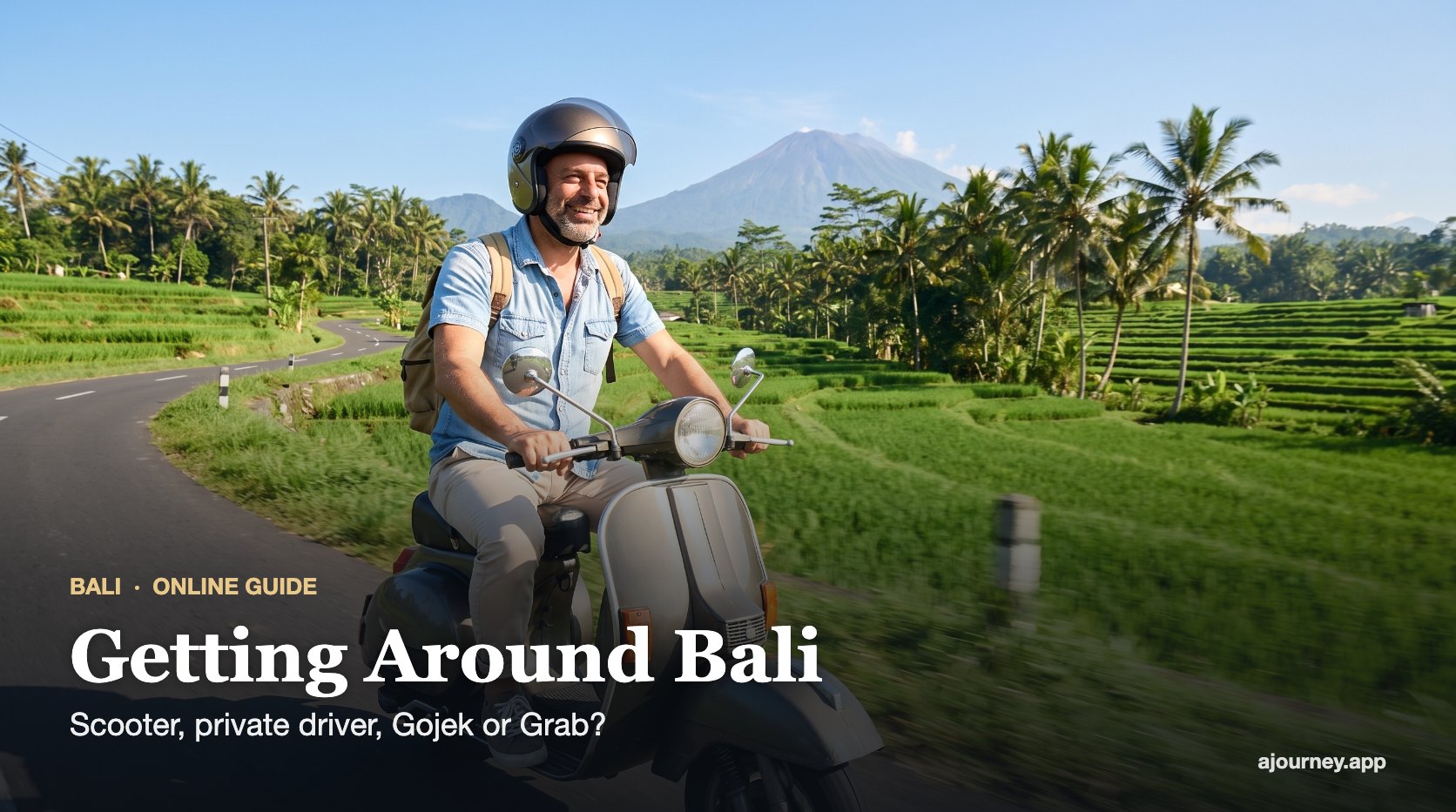
I get around Ubud on a scooter, use Gojek constantly and book a trusted driver for long day trips. Here is my honest guide to every option, what it costs, and which one I would choose for each situation.
My quick recommendations
- Short rides in town: Gojek or Grab (car or motorbike).
- Full-day trips: a private driver—relaxing and great value when shared.
- Scooter: only with a valid motorcycle licence, an International Driving Permit and real riding experience.
- Islands: fast boats from Sanur or Padang Bai.
- Always allow more time than Google Maps says.
1. Gojek and Grab: My Everyday Choice
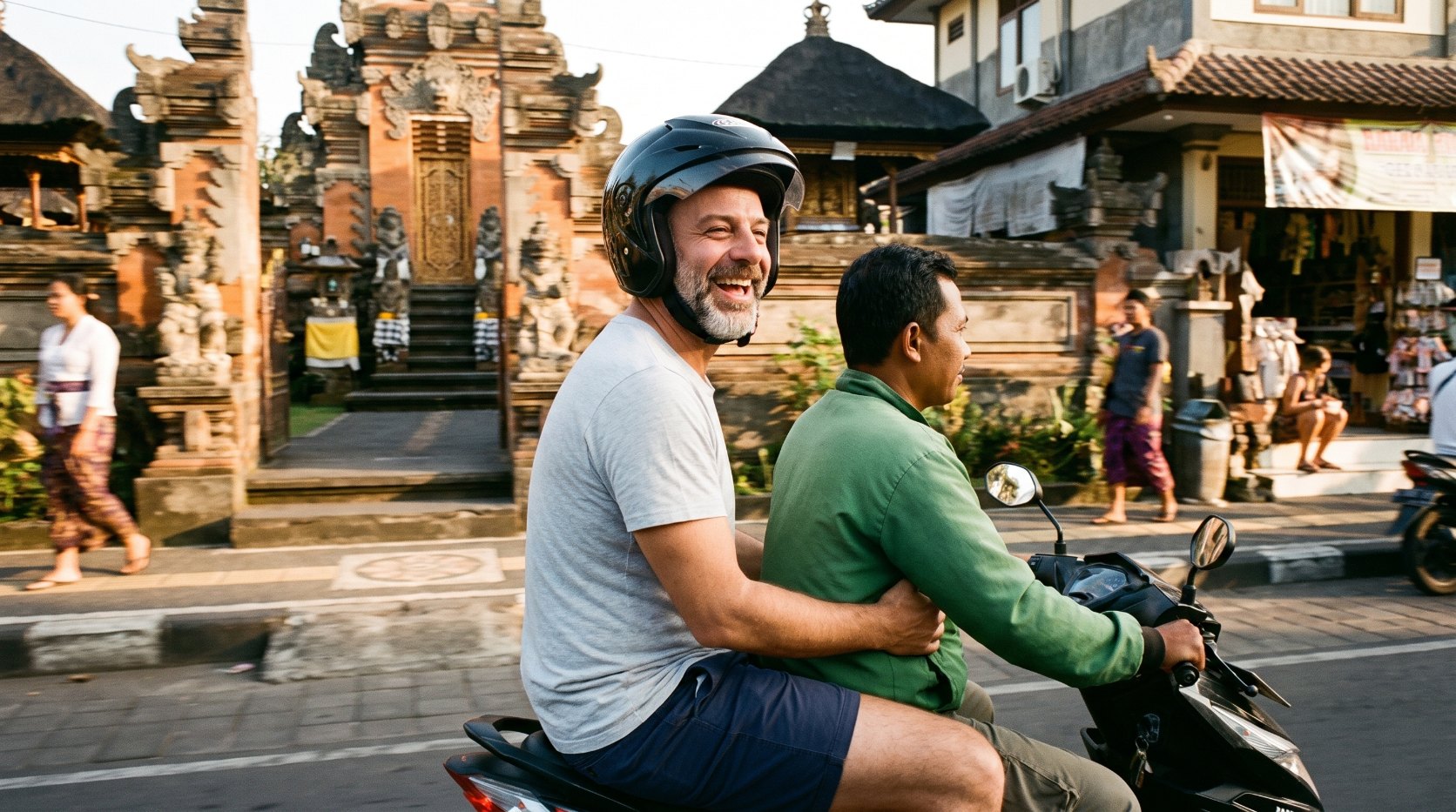
Gojek and Grab are the Uber of Indonesia, and they make Bali so much easier. You see the price before you book, you can follow your driver on the map and pay by card or cash. For short trips, a motorbike ride (GoRide or GrabBike) is fast and cheap and slips through traffic; with luggage or in the rain, choose a car (GoCar or GrabCar).
I personally prefer Gojek because its location search is based on Google Maps, so villas and small places are easier to find. I keep both apps and compare prices. One thing to know: in some areas, local transport groups don’t allow app pick-ups—you may see signs. In that case, walk a little further or book a local driver.
2. Private Driver: The Best Way for Day Trips
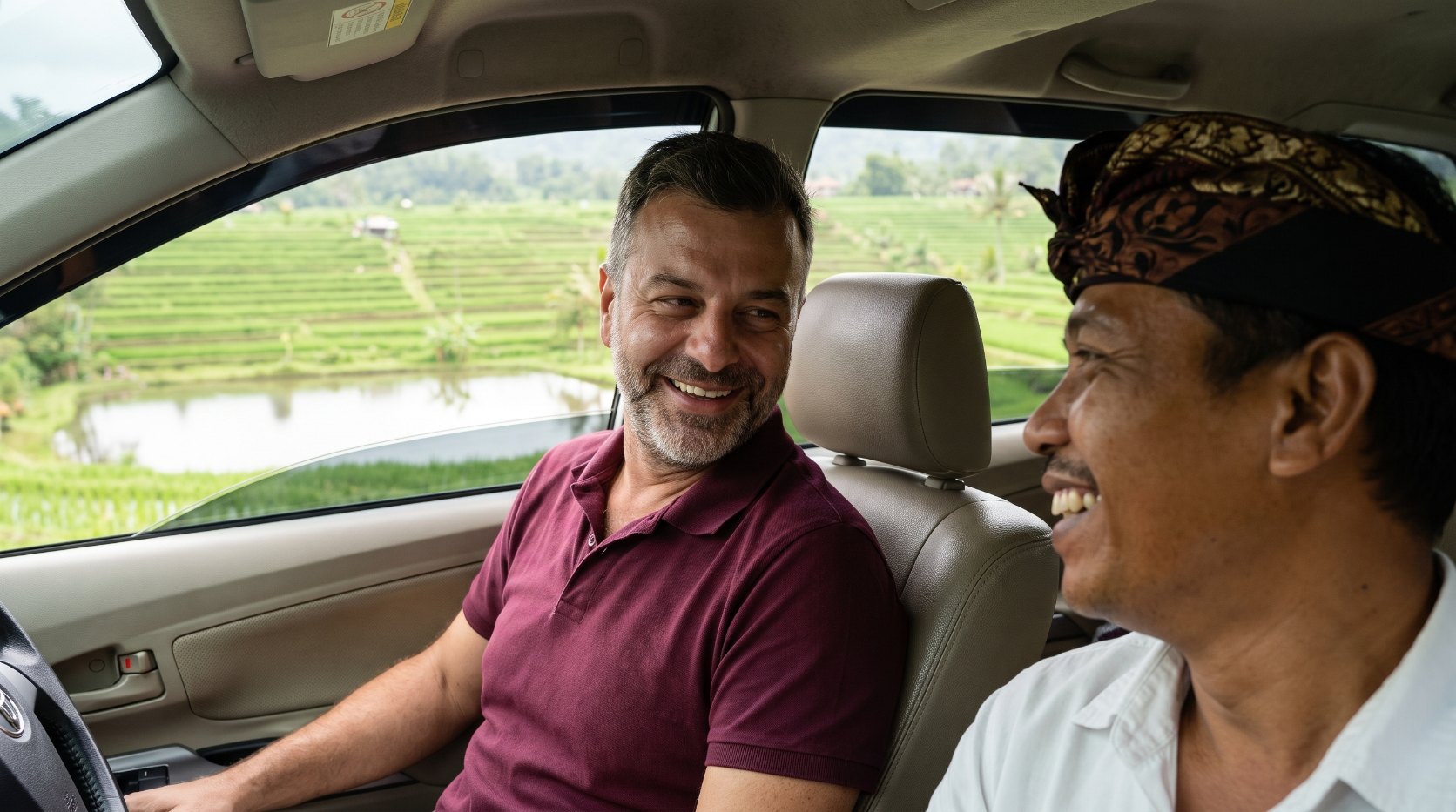
For waterfalls, temples, rice terraces or a trip to the mountains, nothing beats a private driver. A good driver is also a guide: they know the best times to visit, where to eat and how to avoid the worst traffic. A full day typically costs around Rp650,000–1,400,000 per car depending on hours, distance and vehicle—so it is very good value shared between two to four people.
Agree in advance on the hours, the route, what is included (fuel, parking, tolls) and the price for overtime. My own trusted guide is Wandi—I introduce him in my Airport to Your Hotel in Bali guide.
3. Renting a Scooter: Freedom—With Responsibility
A scooter gives you incredible freedom, and it is how I move around Ubud every day. But I want to be very honest: Bali roads are not easy. Traffic is chaotic, roads can be narrow, steep, wet or full of potholes, and accidents involving tourists are very common.
Ride only if:
- You hold a valid motorcycle licence in your home country.
- You have an International Driving Permit that includes the motorcycle category, obtained from your country’s official issuing body before you travel.
- You are already an experienced rider—Bali is not the place to learn.
- You always wear a helmet, fastened, and your passenger does too.
Without the correct licence, police can fine you and, more importantly, your travel insurance may refuse to pay after an accident. I explain this in my Bali Travel Insurance guide. Scooters typically rent for around Rp80,000–250,000 per day, cheaper for weekly or monthly rentals. Check the brakes, tyres and lights, photograph any scratches before you ride and keep the rental papers with you.
4. Taxis
Metered taxis exist, especially in the south. If you take a taxi, use a reputable company, insist on the meter or agree on the full price before you get in. In tourist areas, apps are usually easier.
5. Fast Boats to the Islands

To reach Nusa Penida, Nusa Lembongan and Nusa Ceningan, fast boats leave from Sanur and the crossing is usually short. For the Gili Islands and Lombok, boats leave from Padang Bai, Serangan or other harbours and the trip is much longer. A few tips:
- Book with an established operator and check reviews.
- Sea conditions can change quickly—morning boats are often calmer.
- Expect to wade into the water to board at some beaches: wear sandals and keep your bag waterproof.
- Don’t plan an international flight on the same day as a boat back to Bali.
6. Walking and Cycling
In the centre of Ubud, Sanur and parts of Seminyak, walking is lovely—but pavements can be narrow, broken or blocked, and drainage holes are common. Watch your step, especially at night. Sanur’s beach path and the quiet roads around Ubud’s rice fields are wonderful for cycling.
7. Which Option When? My Quick Comparison
| Situation | My choice |
|---|---|
| Short trip in town | Gojek / Grab motorbike |
| With luggage or in the rain | Gojek / Grab car |
| Full-day sightseeing | Private driver |
| Exploring at your own pace (licensed) | Scooter |
| Nusa Penida or the Gilis | Fast boat |
| Airport to your hotel | Pre-arranged driver or app car |
8. Bali Traffic: What Nobody Tells You
- Distances lie: 20 km can take an hour or more.
- Late afternoon and early evening are the busiest times, especially around Canggu, Seminyak and Ubud.
- Ceremonies and processions can close roads—be patient, it is part of life here.
- Heavy rain slows everything down and makes scooter riding dangerous.
- Plan your days by area to avoid crossing the island repeatedly. My How to Plan Your Bali Itinerary helps with this.
9. My Honest Advice
Use Gojek or Grab for the small trips, book a good driver for the big days, and only ride a scooter if you are licensed and confident. The most beautiful parts of Bali are often just outside the busy centres—getting around well is how you find them.
Frequently Asked Questions
What is the best way to get around Bali?
Gojek or Grab for short trips, a private driver for full-day sightseeing and fast boats for the islands. Scooters are great only for licensed, experienced riders.
Do I need an International Driving Permit to ride a scooter in Bali?
Yes. You need a valid motorcycle licence from home plus an International Driving Permit that includes the motorcycle category. Without it you risk fines and your insurance may not cover you.
How much does a private driver cost in Bali?
Typically around Rp650,000–1,400,000 per car per day, depending on hours, distance and vehicle. Agree on what is included before you start.
Are Gojek and Grab available everywhere in Bali?
In most tourist areas, yes. In some places local transport groups do not allow app pick-ups; walk a little further or use a local driver.
Is there public transport in Bali?
There are some bus routes, but they are limited for travellers. Most visitors use apps, drivers or scooters.
Related Bali Guides
- Airport to Your Hotel in Bali
- Bali Travel Insurance
- How to Plan Your Bali Itinerary
- Where to Stay in Bali
- Safety in Bali
- How Much Does a Trip to Bali Cost?
Follow my Bali life day by day
I share the places, people and little discoveries behind these guides on our Instagram. Say hello and follow us at @ajourney for my real experiences in Bali.
Images are AI-created editorial illustrations using Emre Konuralp’s portrait reference where shown. They illustrate the guide rather than document a specific visit.
By Emre Konuralp · Updated October 2026
“Should I rent a scooter or book a driver?” Whenever I post a video from the road on Instagram, my comments fill with transport questions. I read them all, and many of the answers ended up in this guide. Have a question I didn’t cover? Ask me at @ajourney—I reply to as many messages as I can.
The first thing every visitor learns about Bali: there are no trains, almost no useful public buses for travellers, and the traffic has a personality of its own. Getting around is part of the adventure—and choosing the right way to move makes a huge difference to how much you enjoy your days.
I get around Ubud on a scooter, use Gojek constantly and book a trusted driver for long day trips. Here is my honest guide to every option, what it costs, and which one I would choose for each situation.
My quick recommendations
- Short rides in town: Gojek or Grab (car or motorbike).
- Full-day trips: a private driver—relaxing and great value when shared.
- Scooter: only with a valid motorcycle licence, an International Driving Permit and real riding experience.
- Islands: fast boats from Sanur or Padang Bai.
- Always allow more time than Google Maps says.
1. Gojek and Grab: My Everyday Choice
Gojek and Grab are the Uber of Indonesia, and they make Bali so much easier. You see the price before you book, you can follow your driver on the map and pay by card or cash. For short trips, a motorbike ride (GoRide or GrabBike) is fast and cheap and slips through traffic; with luggage or in the rain, choose a car (GoCar or GrabCar).
I personally prefer Gojek because its location search is based on Google Maps, so villas and small places are easier to find. I keep both apps and compare prices. One thing to know: in some areas, local transport groups don’t allow app pick-ups—you may see signs. In that case, walk a little further or book a local driver.
2. Private Driver: The Best Way for Day Trips
For waterfalls, temples, rice terraces or a trip to the mountains, nothing beats a private driver. A good driver is also a guide: they know the best times to visit, where to eat and how to avoid the worst traffic. A full day typically costs around Rp650,000–1,400,000 per car depending on hours, distance and vehicle—so it is very good value shared between two to four people.
Agree in advance on the hours, the route, what is included (fuel, parking, tolls) and the price for overtime. My own trusted guide is Wandi—I introduce him in my Airport to Your Hotel in Bali guide.
3. Renting a Scooter: Freedom—With Responsibility
A scooter gives you incredible freedom, and it is how I move around Ubud every day. But I want to be very honest: Bali roads are not easy. Traffic is chaotic, roads can be narrow, steep, wet or full of potholes, and accidents involving tourists are very common.
Ride only if:
- You hold a valid motorcycle licence in your home country.
- You have an International Driving Permit that includes the motorcycle category, obtained from your country’s official issuing body before you travel.
- You are already an experienced rider—Bali is not the place to learn.
- You always wear a helmet, fastened, and your passenger does too.
Without the correct licence, police can fine you and, more importantly, your travel insurance may refuse to pay after an accident. I explain this in my Bali Travel Insurance guide. Scooters typically rent for around Rp80,000–250,000 per day, cheaper for weekly or monthly rentals. Check the brakes, tyres and lights, photograph any scratches before you ride and keep the rental papers with you.
4. Taxis
Metered taxis exist, especially in the south. If you take a taxi, use a reputable company, insist on the meter or agree on the full price before you get in. In tourist areas, apps are usually easier.
5. Fast Boats to the Islands
To reach Nusa Penida, Nusa Lembongan and Nusa Ceningan, fast boats leave from Sanur and the crossing is usually short. For the Gili Islands and Lombok, boats leave from Padang Bai, Serangan or other harbours and the trip is much longer. A few tips:
- Book with an established operator and check reviews.
- Sea conditions can change quickly—morning boats are often calmer.
- Expect to wade into the water to board at some beaches: wear sandals and keep your bag waterproof.
- Don’t plan an international flight on the same day as a boat back to Bali.
6. Walking and Cycling
In the centre of Ubud, Sanur and parts of Seminyak, walking is lovely—but pavements can be narrow, broken or blocked, and drainage holes are common. Watch your step, especially at night. Sanur’s beach path and the quiet roads around Ubud’s rice fields are wonderful for cycling.
7. Which Option When? My Quick Comparison
| Situation | My choice |
|---|---|
| Short trip in town | Gojek / Grab motorbike |
| With luggage or in the rain | Gojek / Grab car |
| Full-day sightseeing | Private driver |
| Exploring at your own pace (licensed) | Scooter |
| Nusa Penida or the Gilis | Fast boat |
| Airport to your hotel | Pre-arranged driver or app car |
8. Bali Traffic: What Nobody Tells You
- Distances lie: 20 km can take an hour or more.
- Late afternoon and early evening are the busiest times, especially around Canggu, Seminyak and Ubud.
- Ceremonies and processions can close roads—be patient, it is part of life here.
- Heavy rain slows everything down and makes scooter riding dangerous.
- Plan your days by area to avoid crossing the island repeatedly. My How to Plan Your Bali Itinerary helps with this.
9. My Honest Advice
Use Gojek or Grab for the small trips, book a good driver for the big days, and only ride a scooter if you are licensed and confident. The most beautiful parts of Bali are often just outside the busy centres—getting around well is how you find them.
Frequently Asked Questions
What is the best way to get around Bali?
Gojek or Grab for short trips, a private driver for full-day sightseeing and fast boats for the islands. Scooters are great only for licensed, experienced riders.
Do I need an International Driving Permit to ride a scooter in Bali?
Yes. You need a valid motorcycle licence from home plus an International Driving Permit that includes the motorcycle category. Without it you risk fines and your insurance may not cover you.
How much does a private driver cost in Bali?
Typically around Rp650,000–1,400,000 per car per day, depending on hours, distance and vehicle. Agree on what is included before you start.
Are Gojek and Grab available everywhere in Bali?
In most tourist areas, yes. In some places local transport groups do not allow app pick-ups; walk a little further or use a local driver.
Is there public transport in Bali?
There are some bus routes, but they are limited for travellers. Most visitors use apps, drivers or scooters.
Related Bali Guides
- Airport to Your Hotel in Bali
- Bali Travel Insurance
- How to Plan Your Bali Itinerary
- Where to Stay in Bali
- Safety in Bali
- How Much Does a Trip to Bali Cost?
Follow my Bali life day by day
I share the places, people and little discoveries behind these guides on our Instagram. Say hello and follow us at @ajourney for my real experiences in Bali.
Images are AI-created editorial illustrations using Emre Konuralp’s portrait reference where shown. They illustrate the guide rather than document a specific visit.