


Living in Bali has completely changed the way I pack for the island. Bali is warm and humid, but a single day can take me from a sunny beach to the cooler air of Ubud or Kintamani, then into a sacred temple and finally through a sudden tropical shower. Because of that, I no longer try to pack for every possible situation. I choose light, versatile pieces that keep me comfortable, respectful and ready to change plans.
This is the packing approach that works for me in Bali. You may want to adjust it to your own travel style, but these are the items I genuinely find useful—and the things I have learned I can comfortably leave behind.
WHAT I PACK FOR BALI: MY ESSENTIAL CHECKLIST
I prefer to travel light and leave some empty space in my suitcase. Laundry services are easy to find and affordable in Bali, so I would rather wash a few favourite pieces than carry too many clothes. I also like having room for a locally made sarong, resort wear or small discoveries I find along the way.
LIGHTWEIGHT, BREATHABLE CLOTHING
- Loose cotton or linen shirts and T-shirts
- Lightweight shorts, skirts and trousers
- Comfortable dresses or relaxed evening wear
- Underwear and sleepwear suited to a humid climate
- One light layer for air-conditioned spaces and cooler evenings
I avoid bringing too much heavy denim or thick synthetic clothing because it can feel uncomfortable in Bali’s humidity and takes longer to dry. Around the coast, I usually choose the lightest fabrics I have. In Ubud, Munduk, Kintamani or Bedugul—especially after rain or in the evening—I am often glad to have one thin extra layer with me.
SWIMWEAR AND BEACH ESSENTIALS
- Two swimsuits, so one can dry while I use the other
- A lightweight cover-up
- A quick-dry towel when my accommodation does not provide one
- A waterproof phone pouch or small dry bag
- Reef-conscious sunscreen, sunglasses and a hat
If I am planning a surfing, snorkelling or waterfall day, I also take a rash guard. It gives me extra sun protection and is more practical than repeatedly applying sunscreen. I do not always carry water shoes, but I find them useful for rocky beaches, slippery waterfall paths and certain water activities.
HOW I DRESS FOR TEMPLES
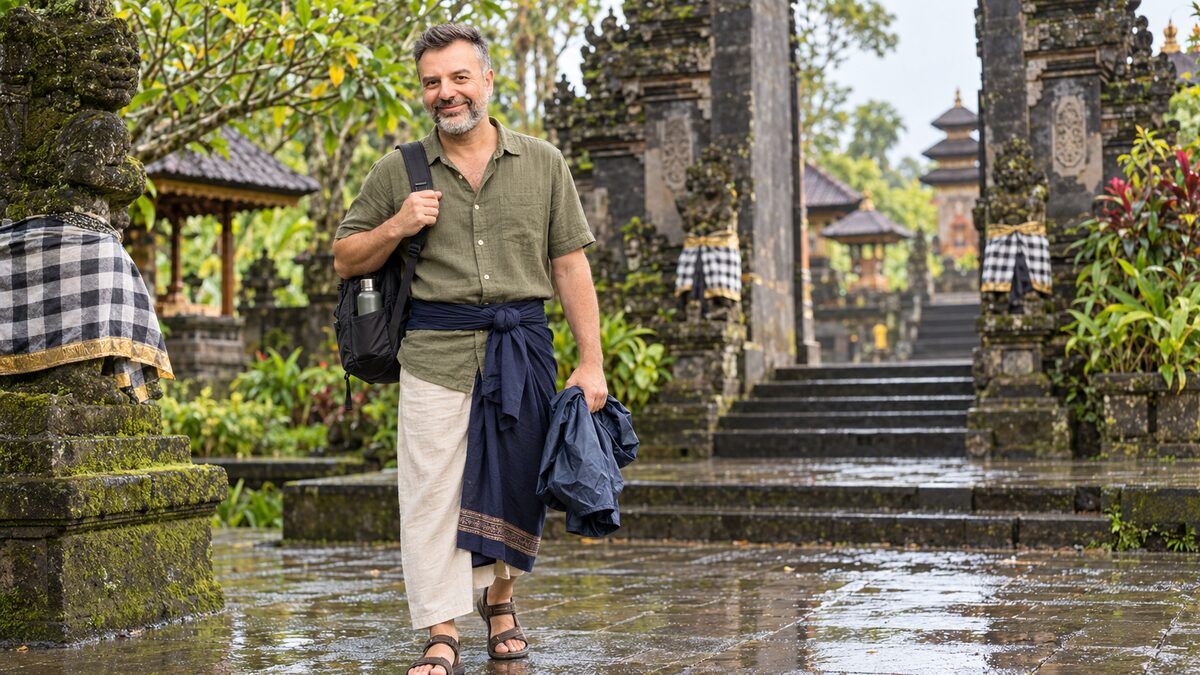
Bali feels relaxed, but I never treat temple clothing casually. I make sure my shoulders and knees are covered, and I usually carry my own lightweight sarong. Many temples provide or rent a sarong and sash at the entrance, but having my own has made spontaneous temple visits much easier.
I also keep one modest top and a light pair of long trousers—or a longer skirt—ready for sacred sites. In my experience, arriving prepared feels more respectful and allows me to focus on the place itself rather than trying to solve my clothing at the entrance. I would also avoid entering a temple directly from the beach in wet swimwear or very revealing clothes.
FOOTWEAR: WHY I KEEP IT SIMPLE
- Comfortable sandals for everyday use
- Walking shoes or trainers with reliable grip
- Flip-flops for the beach, pool and accommodation
I rarely need heavy hiking boots in Bali. For most days, good sandals and comfortable walking shoes are enough. If I am going to Mount Batur, a waterfall with a steep path or a longer nature walk, I choose closed shoes with proper traction. Smooth-soled fashion trainers can become surprisingly slippery after tropical rain.
RAIN, SUN AND MOSQUITO PROTECTION
I always keep a compact rain jacket or poncho in my daypack, even when the morning looks clear. Tropical rain can arrive very quickly, particularly during the wetter months. If I expect to spend time on a scooter or around waterfalls, I also use a small waterproof cover or dry bag for my essentials.
For everyday protection, I carry high-SPF sunscreen and mosquito repellent. I prefer bringing products that I already know work well with my skin. You can buy both in Bali, but familiar imported brands may cost more, and searching for the right product is not how I want to spend the first day of my trip.
MY SMALL HEALTH AND PERSONAL-CARE KIT
- My regular prescription medication in its original packaging
- A copy of the prescription or a doctor’s letter when appropriate
- Basic pain relief, plasters and antiseptic
- Oral rehydration salts and digestive remedies I already trust
- Hand sanitiser and tissues
- Personal-care products or brands I strongly prefer
Pharmacies are easy to find in Bali’s main tourist areas, so I do not carry an entire medicine cabinet. I simply bring a compact kit for common situations and anything specific that I would not want to search for after arrival. If you travel with controlled medication, I strongly recommend checking Indonesia’s current rules before your flight, as a product that is legal in another country may be restricted here.
TECH, POWER AND CONNECTIVITY
- My phone, charging cable and power bank
- A universal travel adapter
- Camera equipment and spare memory cards when needed
- A water-resistant pouch for electronics
- Offline copies of bookings, insurance and important addresses
I use my phone for maps, bookings, transport and communication throughout the day, so a power bank is one of the items I appreciate most. Indonesia commonly uses two round-pin plugs—types C and F—with a 230V/50Hz supply. Most modern chargers accept this voltage, but I always check the label on each device rather than assume.
DOCUMENTS AND MONEY
- A passport with sufficient validity for the trip
- The visa and arrival documents required for my travel date
- Travel insurance details
- The correct driving licence and international permit if I plan to drive
- At least two payment cards stored separately
- A small amount of Indonesian rupiah for arrival and minor expenses
- Digital and offline copies of essential documents
I never keep every payment method and important document in the same place. Separating my cards and keeping offline copies gives me peace of mind. Entry requirements can change, so I also check the current official information shortly before travelling instead of relying on an old checklist or a social media post.
WHAT I KEEP IN MY EVERYDAY BALI DAYPACK
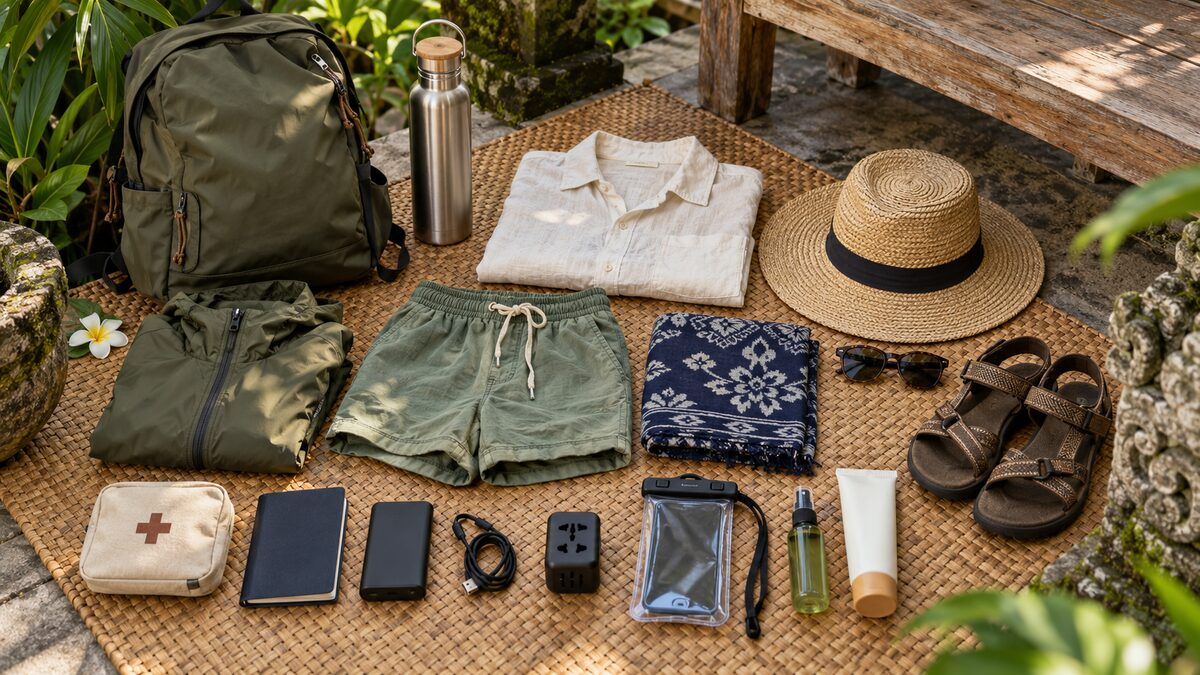
A small, comfortable daypack is one of the most useful things I carry in Bali. On a normal day, mine usually contains water, sunscreen, mosquito repellent, a sarong, a compact rain layer, tissues, a power bank and a waterproof pouch. I also use a reusable water bottle, but I fill it only from a safe drinking-water source because I do not drink Bali’s tap water.
WHAT I LEAVE AT HOME
- Too many formal outfits
- Heavy denim and thick synthetic clothing
- Several pairs of bulky shoes
- Expensive jewellery that I would worry about
- A full-size toiletries collection
- An overfilled suitcase with no room for local finds
I have found that packing more does not make me feel more prepared in Bali—it usually just gives me a heavier suitcase and more decisions to make. Versatile pieces that I genuinely enjoy wearing are far more useful than a different outfit for every imagined occasion.
HOW I ADJUST FOR THE SEASON
DRIER MONTHS
During the drier period, I prioritise breathable clothing, sun protection and a light layer for breezy evenings or air-conditioned transport. I still keep a compact rain layer nearby because tropical weather does not always follow the forecast.
WETTER MONTHS
In the wetter months, I rely more on quick-dry clothing, footwear with good grip and proper waterproof protection for electronics. I avoid heavy items that remain damp for a long time. A better rain jacket is worth the small amount of suitcase space it takes.
MY FINAL PACKING ADVICE
If I had to reduce this guide to one principle, it would be this: I pack for heat, sudden rain, sacred spaces and spontaneous plans—but I do not try to carry my whole wardrobe. I choose pieces that can move easily from a café to a beach, waterfall or temple. That approach keeps me comfortable, helps me respect the local culture and leaves enough space to bring a little piece of Bali home.
Living in Bali has completely changed the way I pack for the island. Bali is warm and humid, but a single day can take me from a sunny beach to the cooler air of Ubud or Kintamani, then into a sacred temple and finally through a sudden tropical shower. Because of that, I no longer try to pack for every possible situation. I choose light, versatile pieces that keep me comfortable, respectful and ready to change plans.
This is the packing approach that works for me in Bali. You may want to adjust it to your own travel style, but these are the items I genuinely find useful—and the things I have learned I can comfortably leave behind.
WHAT I PACK FOR BALI: MY ESSENTIAL CHECKLIST
I prefer to travel light and leave some empty space in my suitcase. Laundry services are easy to find and affordable in Bali, so I would rather wash a few favourite pieces than carry too many clothes. I also like having room for a locally made sarong, resort wear or small discoveries I find along the way.
LIGHTWEIGHT, BREATHABLE CLOTHING
- Loose cotton or linen shirts and T-shirts
- Lightweight shorts, skirts and trousers
- Comfortable dresses or relaxed evening wear
- Underwear and sleepwear suited to a humid climate
- One light layer for air-conditioned spaces and cooler evenings
I avoid bringing too much heavy denim or thick synthetic clothing because it can feel uncomfortable in Bali’s humidity and takes longer to dry. Around the coast, I usually choose the lightest fabrics I have. In Ubud, Munduk, Kintamani or Bedugul—especially after rain or in the evening—I am often glad to have one thin extra layer with me.
SWIMWEAR AND BEACH ESSENTIALS
- Two swimsuits, so one can dry while I use the other
- A lightweight cover-up
- A quick-dry towel when my accommodation does not provide one
- A waterproof phone pouch or small dry bag
- Reef-conscious sunscreen, sunglasses and a hat
If I am planning a surfing, snorkelling or waterfall day, I also take a rash guard. It gives me extra sun protection and is more practical than repeatedly applying sunscreen. I do not always carry water shoes, but I find them useful for rocky beaches, slippery waterfall paths and certain water activities.
HOW I DRESS FOR TEMPLES
Bali feels relaxed, but I never treat temple clothing casually. I make sure my shoulders and knees are covered, and I usually carry my own lightweight sarong. Many temples provide or rent a sarong and sash at the entrance, but having my own has made spontaneous temple visits much easier.
I also keep one modest top and a light pair of long trousers—or a longer skirt—ready for sacred sites. In my experience, arriving prepared feels more respectful and allows me to focus on the place itself rather than trying to solve my clothing at the entrance. I would also avoid entering a temple directly from the beach in wet swimwear or very revealing clothes.
FOOTWEAR: WHY I KEEP IT SIMPLE
- Comfortable sandals for everyday use
- Walking shoes or trainers with reliable grip
- Flip-flops for the beach, pool and accommodation
I rarely need heavy hiking boots in Bali. For most days, good sandals and comfortable walking shoes are enough. If I am going to Mount Batur, a waterfall with a steep path or a longer nature walk, I choose closed shoes with proper traction. Smooth-soled fashion trainers can become surprisingly slippery after tropical rain.
RAIN, SUN AND MOSQUITO PROTECTION
I always keep a compact rain jacket or poncho in my daypack, even when the morning looks clear. Tropical rain can arrive very quickly, particularly during the wetter months. If I expect to spend time on a scooter or around waterfalls, I also use a small waterproof cover or dry bag for my essentials.
For everyday protection, I carry high-SPF sunscreen and mosquito repellent. I prefer bringing products that I already know work well with my skin. You can buy both in Bali, but familiar imported brands may cost more, and searching for the right product is not how I want to spend the first day of my trip.
MY SMALL HEALTH AND PERSONAL-CARE KIT
- My regular prescription medication in its original packaging
- A copy of the prescription or a doctor’s letter when appropriate
- Basic pain relief, plasters and antiseptic
- Oral rehydration salts and digestive remedies I already trust
- Hand sanitiser and tissues
- Personal-care products or brands I strongly prefer
Pharmacies are easy to find in Bali’s main tourist areas, so I do not carry an entire medicine cabinet. I simply bring a compact kit for common situations and anything specific that I would not want to search for after arrival. If you travel with controlled medication, I strongly recommend checking Indonesia’s current rules before your flight, as a product that is legal in another country may be restricted here.
TECH, POWER AND CONNECTIVITY
- My phone, charging cable and power bank
- A universal travel adapter
- Camera equipment and spare memory cards when needed
- A water-resistant pouch for electronics
- Offline copies of bookings, insurance and important addresses
I use my phone for maps, bookings, transport and communication throughout the day, so a power bank is one of the items I appreciate most. Indonesia commonly uses two round-pin plugs—types C and F—with a 230V/50Hz supply. Most modern chargers accept this voltage, but I always check the label on each device rather than assume.
DOCUMENTS AND MONEY
- A passport with sufficient validity for the trip
- The visa and arrival documents required for my travel date
- Travel insurance details
- The correct driving licence and international permit if I plan to drive
- At least two payment cards stored separately
- A small amount of Indonesian rupiah for arrival and minor expenses
- Digital and offline copies of essential documents
I never keep every payment method and important document in the same place. Separating my cards and keeping offline copies gives me peace of mind. Entry requirements can change, so I also check the current official information shortly before travelling instead of relying on an old checklist or a social media post.
WHAT I KEEP IN MY EVERYDAY BALI DAYPACK
A small, comfortable daypack is one of the most useful things I carry in Bali. On a normal day, mine usually contains water, sunscreen, mosquito repellent, a sarong, a compact rain layer, tissues, a power bank and a waterproof pouch. I also use a reusable water bottle, but I fill it only from a safe drinking-water source because I do not drink Bali’s tap water.
WHAT I LEAVE AT HOME
- Too many formal outfits
- Heavy denim and thick synthetic clothing
- Several pairs of bulky shoes
- Expensive jewellery that I would worry about
- A full-size toiletries collection
- An overfilled suitcase with no room for local finds
I have found that packing more does not make me feel more prepared in Bali—it usually just gives me a heavier suitcase and more decisions to make. Versatile pieces that I genuinely enjoy wearing are far more useful than a different outfit for every imagined occasion.
HOW I ADJUST FOR THE SEASON
DRIER MONTHS
During the drier period, I prioritise breathable clothing, sun protection and a light layer for breezy evenings or air-conditioned transport. I still keep a compact rain layer nearby because tropical weather does not always follow the forecast.
WETTER MONTHS
In the wetter months, I rely more on quick-dry clothing, footwear with good grip and proper waterproof protection for electronics. I avoid heavy items that remain damp for a long time. A better rain jacket is worth the small amount of suitcase space it takes.
MY FINAL PACKING ADVICE
If I had to reduce this guide to one principle, it would be this: I pack for heat, sudden rain, sacred spaces and spontaneous plans—but I do not try to carry my whole wardrobe. I choose pieces that can move easily from a café to a beach, waterfall or temple. That approach keeps me comfortable, helps me respect the local culture and leaves enough space to bring a little piece of Bali home.