

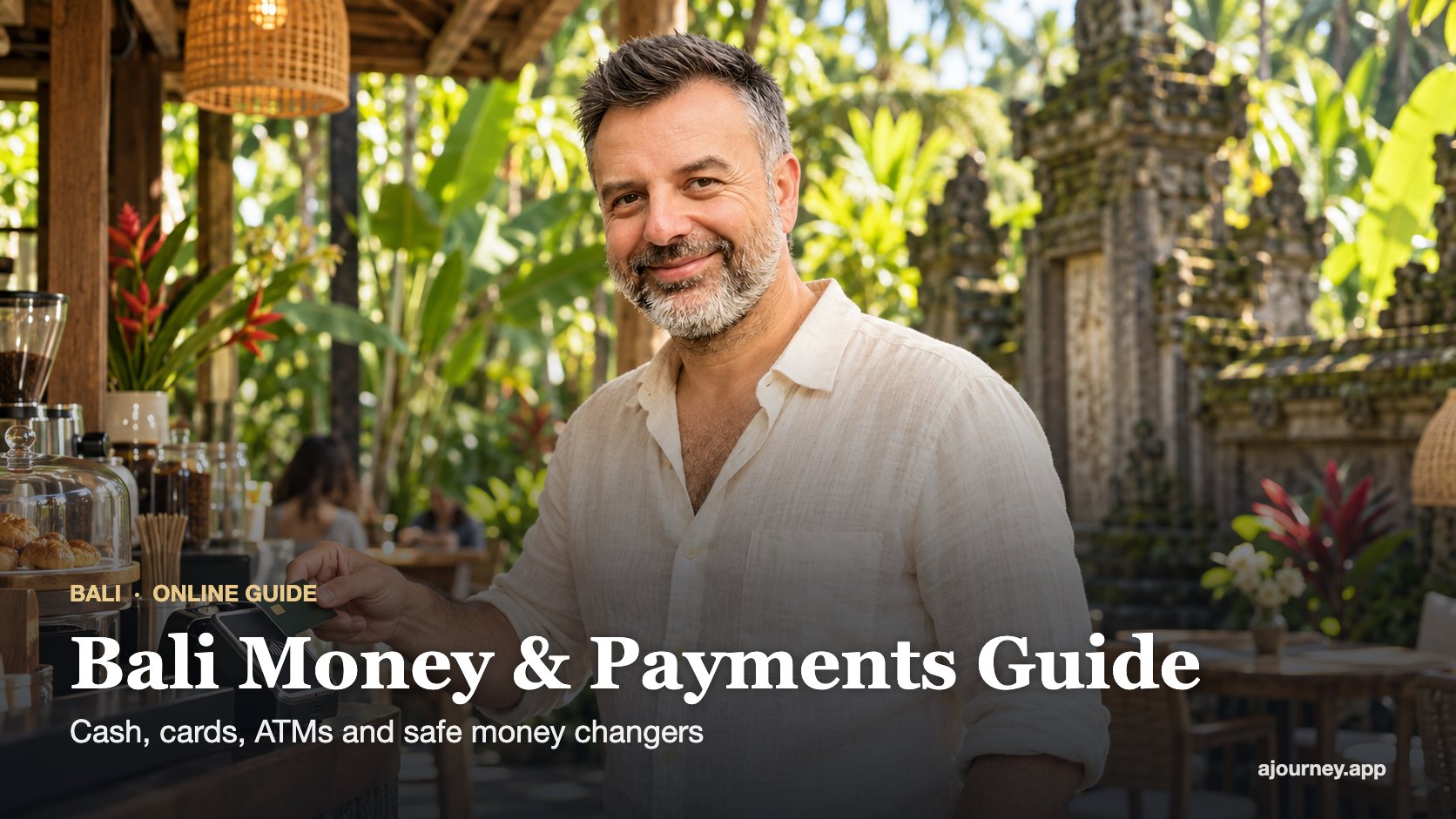
By Emre Konuralp · Updated October 2026
“Cash or card?” “Which ATM should I use?” “Is the money changer safe?” Money questions fill my Instagram DMs every single week. So I put everything I have learned living in Bali into this guide. Have a question I haven’t answered? Message me at @ajourney.
Money in Bali looks simple at first: the local currency is the Indonesian Rupiah, cards are widely accepted in tourist areas and ATMs are easy to find. In practice, the small details—what type of card you bring, which ATM you use, the condition of your cash and where you exchange it—can make a noticeable difference.
I live in Bali and I generally pay by card for most of my purchases. The extra cost is often similar to the combined exchange-rate loss and withdrawal charges involved in obtaining cash. Still, I always carry some rupiah because smaller warungs, local markets, parking attendants, temples and rural businesses may accept cash only.
Last updated: October 2026
ATM limits, bank charges, exchange policies and merchant practices can change. Always check the amount and exchange rate shown before confirming a transaction.
My money system in Bali
- Bring a debit card linked to your current account, plus a backup card kept separately.
- Pay by card at hotels, restaurants and supermarkets; keep cash for warungs, markets, temples, parking and tips.
- Use bank ATMs (my first choice is Maybank) and always choose to be charged in Indonesian Rupiah.
- Exchange money only at authorised money changers and count it yourself.
- At the airport, change only around US$50–100 for your first day.
The Currency Used in Bali
Bali uses the Indonesian Rupiah (IDR), written as Rp. The large numbers can be confusing during the first few days. Banknotes commonly used by travellers include Rp10,000, Rp20,000, Rp50,000 and Rp100,000.
Take a moment to check the number of zeros before paying. The Rp10,000 and Rp100,000 notes can be confused when you are distracted, especially in dim lighting.
My Preferred ATM in Bali: Maybank
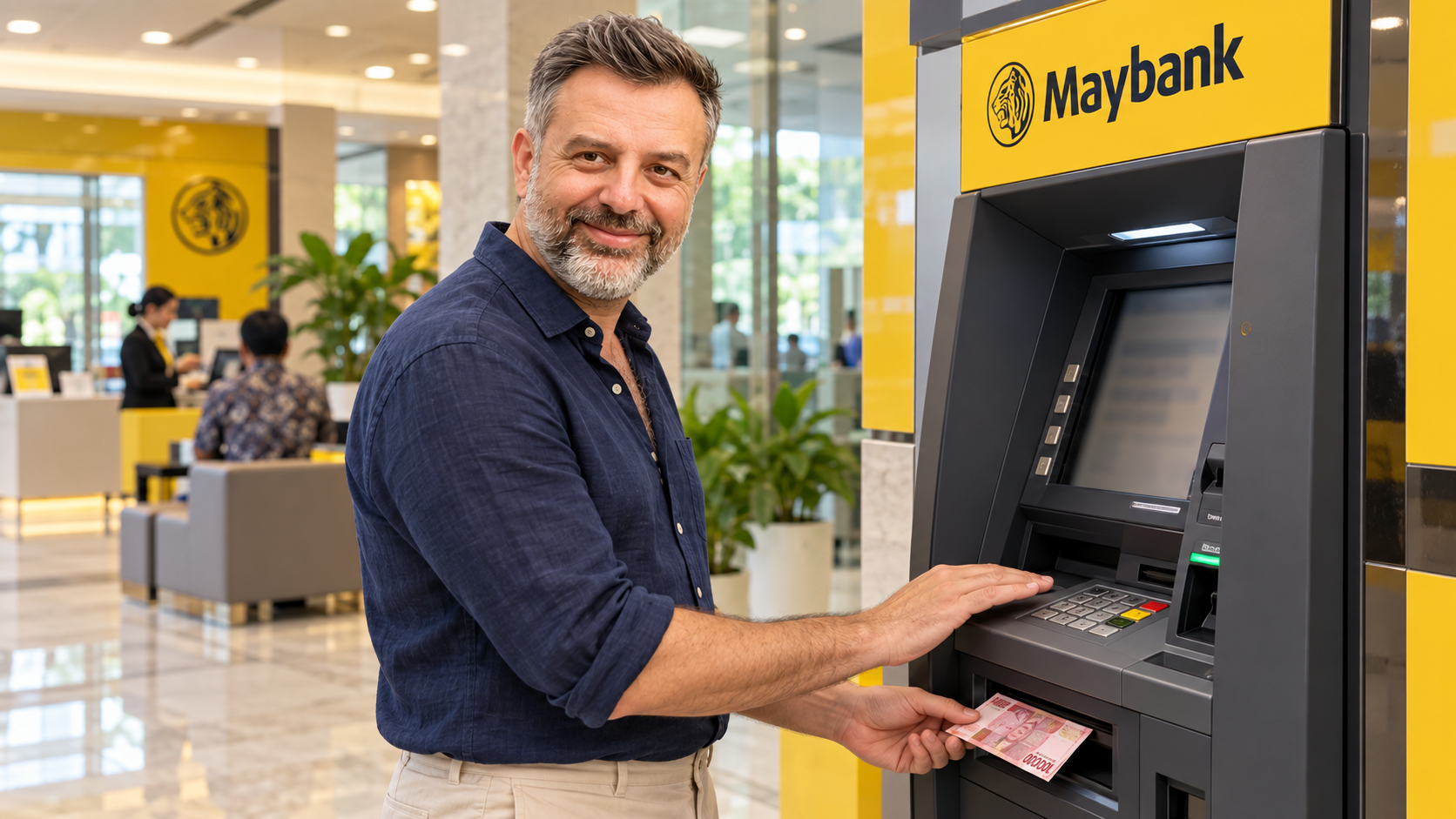
In my own experience, Maybank is usually my first choice for cash withdrawals. Its ATMs are common in the main tourist areas, and many machines allow a withdrawal of up to Rp3,000,000 in one transaction. This can reduce the number of separate withdrawals—and therefore the number of possible fees—compared with machines that limit each transaction to Rp1,250,000 or Rp1,500,000.
The exact amount offered can depend on the ATM, the notes loaded in the machine and the limits imposed by your own bank. The fee you ultimately pay may also include charges from your home bank and its currency-conversion rate.
Bring a Debit Card—not Only a Credit Card
This is one of the most important details in this guide. Bring a debit card linked directly to your current or savings account. An Indonesian ATM generally cannot access a deposit account that sits behind your credit-card relationship in the way your home bank may display it.
If you withdraw with a credit card, the transaction is normally treated as a cash advance. That may trigger a cash-advance fee, interest from the transaction date and a less favourable exchange rate. Your credit-card provider’s rules determine the final cost.
My recommendation is to travel with:
- At least one Visa or Mastercard debit card
- A second card stored separately as a backup
- A credit card for purchases and emergencies
- Enough cash for your arrival and situations where cards are not accepted
Always Choose Indonesian Rupiah at the ATM
Some ATMs offer to convert the withdrawal into your home currency and show a guaranteed amount. This is called dynamic currency conversion. The convenience can hide an unfavourable exchange rate.
I normally decline the ATM’s conversion and choose to be charged in IDR. This lets my own card provider perform the conversion. Read the wording carefully: the buttons can be designed in a way that makes the expensive option look safer.
ATM Safety
- Prefer ATMs inside a bank branch, shopping centre or well-lit lobby.
- Check that the card slot and keypad do not look loose or altered.
- Cover the keypad while entering your PIN.
- Do not accept help from strangers.
- Take your cash, card and receipt before leaving.
- Turn on transaction notifications in your banking app.
- If possible, temporarily freeze a lost card immediately through the app.
Paying by Card in Bali
Credit and debit cards are accepted at most hotels, established restaurants, supermarkets, spas, beach clubs and larger shops in tourist areas. Visa and Mastercard have the widest acceptance. Cash is still important for local markets, small warungs, street vendors and businesses outside the main visitor centres.
In practice, some businesses add around 2–3% when you pay by card. However, Indonesian payment rules generally state that merchants should not pass card surcharges directly to customers. If an extra amount appears, ask whether it is a card fee, tax or service charge and request a receipt.
I personally use my card for most everyday spending. A 2–3% difference can be close to what I would lose through cash exchange margins and ATM or home-bank charges. More importantly, card payments reduce the need to carry and repeatedly count large bundles of rupiah. Your own bank’s foreign-transaction fee may change this calculation, so check it before travelling.
Cash or Card: What I Use
- Card: hotels, restaurants, supermarkets, established cafés, spas and larger purchases
- Cash: small warungs, local markets, temples, parking, tips and rural areas
- Backup: a second card and a separate emergency cash reserve
Where to Exchange Money Safely
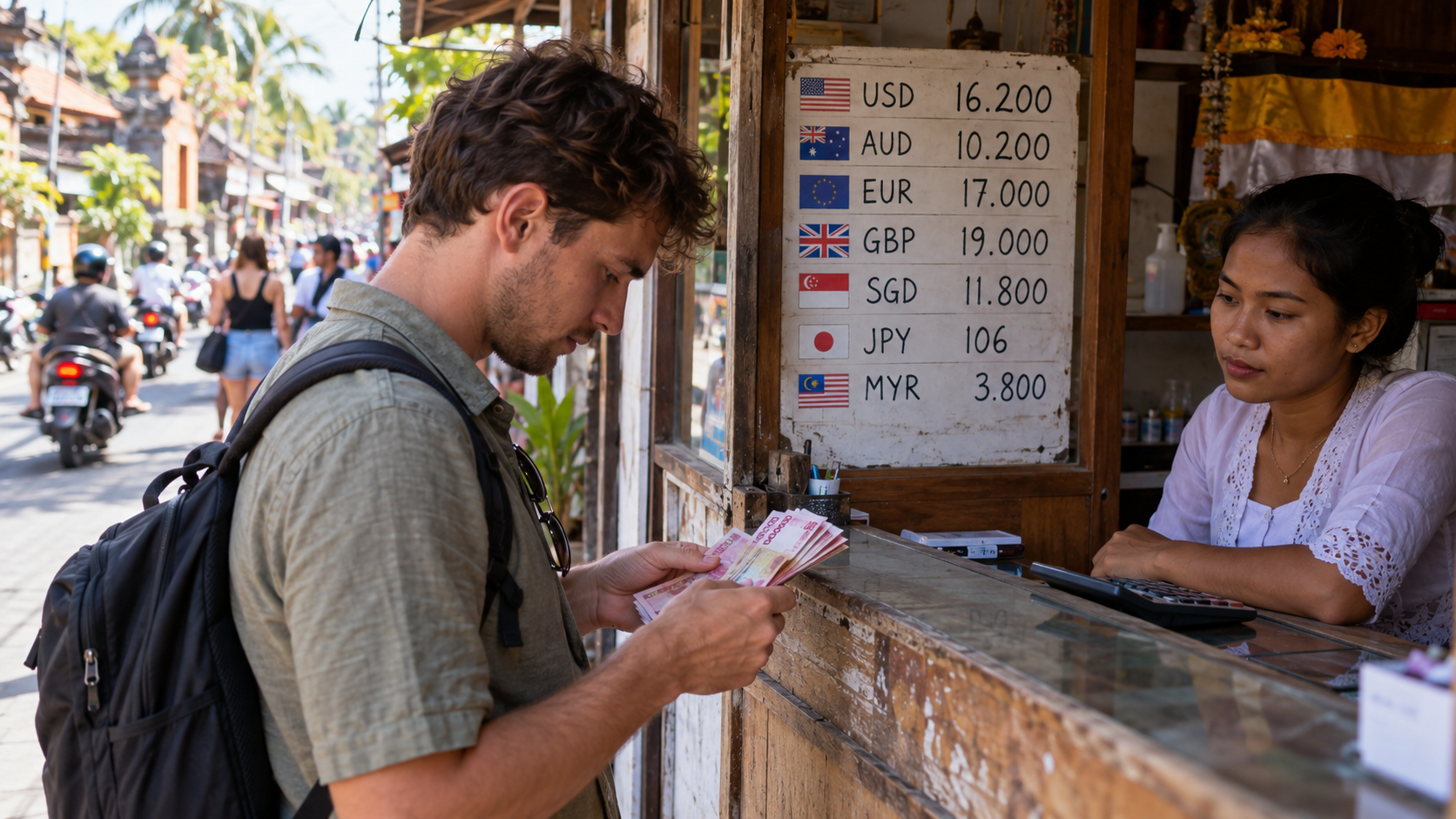
You will see many exchange counters in Bali. Small roadside booths sometimes display a rate that is noticeably better than every other shop nearby. The difference can be tempting, but an unrealistic rate is a reason to slow down—not rush inside.
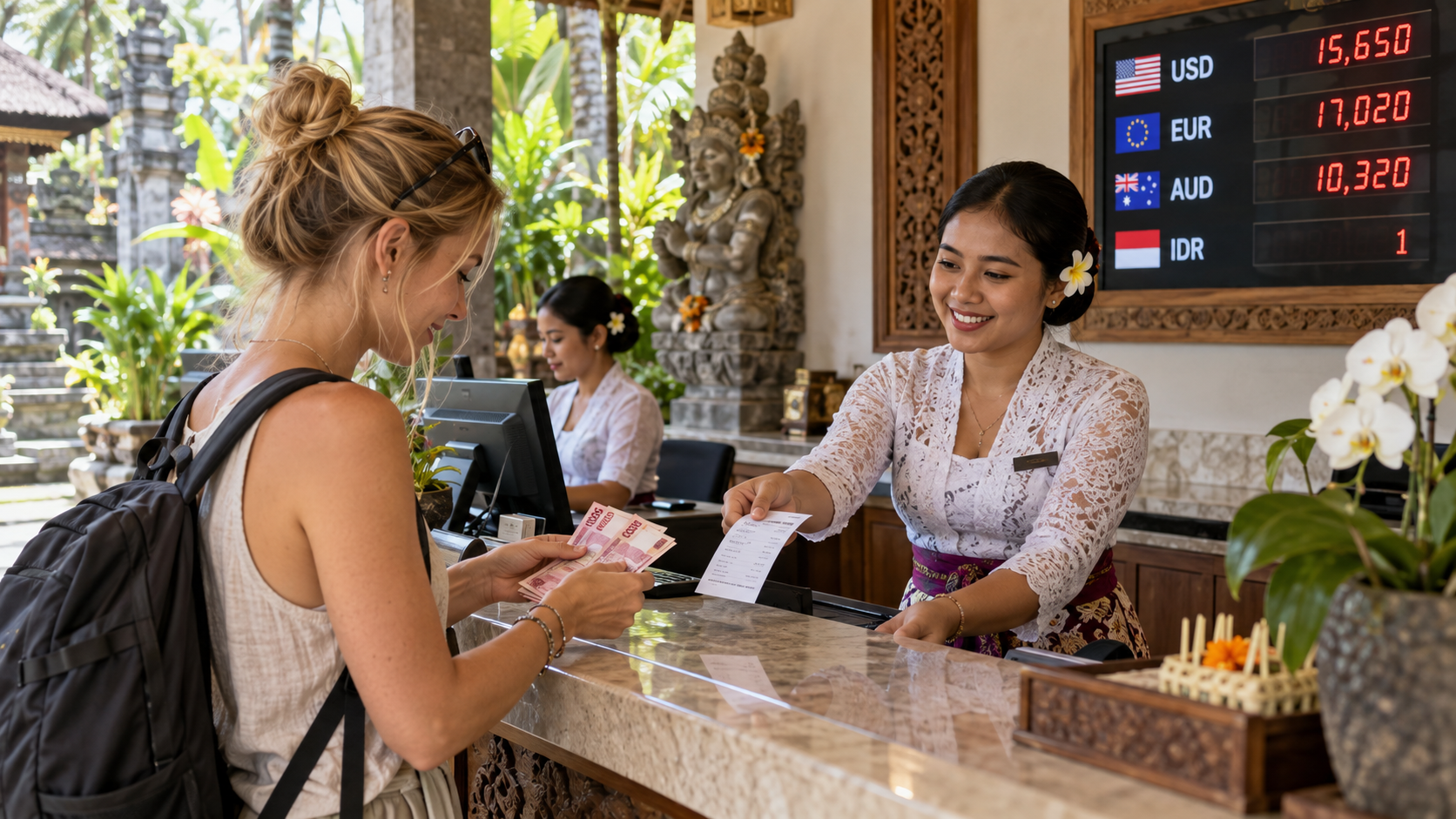
I recommend choosing an established, professional-looking authorised money changer. The counter should display rates clearly, count the money in front of you and provide a printed receipt. Count the rupiah yourself before leaving the counter. Do not let the notes be taken back and handled again after you have completed your count.
My Money-Changer Checklist
- Compare the displayed rate with several nearby counters.
- Avoid a rate that looks too good to be true.
- Ask whether any commission or fee will be deducted.
- Watch the entire counting process.
- Count the rupiah yourself at the counter.
- Request and keep the receipt.
- Do not exchange money in a rushed or distracting environment.
Old or Damaged US Dollar Notes
Although older US dollar designs remain legal tender in the United States, foreign exchange businesses are free to apply their own acceptance policies. In Bali, many money changers reject—or offer a lower rate for—older, marked, torn, taped, heavily folded or otherwise damaged notes.
The most commonly reported difficulty concerns older-design US$100 notes, particularly notes dated before 2006. This should not be treated as a single official island-wide law: policies vary between banks and money changers. The safest choice is to bring recent-design, clean and undamaged US$100 notes. Check every note before leaving home.
Why the Highest Exchange Rate Is Not Always the Best Deal
A booth can advertise a very high rate and then introduce a commission, count the money in confusing piles or use distraction during the handover. Problems are not common at reputable businesses, but it only takes one bad exchange to erase the benefit of a slightly better rate.
For me, a transparent transaction with a receipt is more valuable than chasing the last few rupiah. Reliability matters more than the number on the street sign.
Should You Exchange Money at Bali Airport?
Airport exchange counters are convenient but usually do not offer the best rate. I would not exchange a large amount there. However, changing around US$50–100 can be reasonable if you want cash for your first transport, food, tips or small expenses before reaching your accommodation.
ATMs are also available at the airport. If you use one, apply the same rules: choose IDR, check the transaction amount carefully and use a debit card rather than a credit card cash advance.
For my complete step-by-step routine after landing—arrival card, e-gates, first cash, SIM card and transport—see my Bali Airport Arrival Guide.
My Practical Arrival Strategy
- Arrive with a debit card, a backup card and clean recent cash.
- Withdraw rupiah from a bank ATM at the airport or exchange only a small arrival amount.
- Use a trusted money changer later if you brought cash.
- Pay by card at established businesses when the total cost is reasonable.
- Keep enough cash for smaller local transactions.
- Never keep all cards and cash in the same wallet.
My Final Advice
There is no single payment method that works best everywhere in Bali. My own system is a combination: I use cards for most established businesses, a Maybank ATM when I need rupiah and reputable money changers when exchanging cash.
The essentials are simple: bring a debit card, avoid credit-card cash advances, choose IDR at the ATM, use clean recent banknotes, count your money carefully and keep a receipt. These small habits make payments in Bali much easier and safer.
Important: This guide reflects my personal experience and general travel information. Bank fees, ATM limits, exchange policies and merchant practices can change. Confirm charges with your bank and review every transaction before approving it.
Frequently Asked Questions
What currency is used in Bali?
Bali uses the Indonesian Rupiah (IDR, written Rp). Common notes for travellers include Rp10,000, Rp20,000, Rp50,000 and Rp100,000—check the zeros carefully before paying.
Can I use my credit card in Bali?
Yes, Visa and Mastercard are widely accepted at hotels, established restaurants, supermarkets and larger shops in tourist areas. Cash is still needed for small warungs, markets and rural areas.
Which ATM is best in Bali?
In my experience Maybank ATMs are convenient and many allow up to Rp3,000,000 per withdrawal. Use machines inside banks or shopping centres and always choose to be charged in rupiah.
Is it safe to use money changers in Bali?
Yes, if you use an established, authorised money changer. Be wary of small booths advertising unusually high rates, count the money yourself and ask for a receipt.
Should I bring US dollars to Bali?
Clean, recent US dollar notes can be useful as a backup. Many money changers reject or offer lower rates for old, marked, torn or heavily folded notes.
Related Bali Guides
- Bali Airport Arrival Guide
- Bali Visa & Entry Guide
- Flights to Bali
- Bali SIM Card & Internet Guide
- What to Pack for Bali
- Bali Climate & Weather
- Culture & Etiquette in Bali
- Safety in Bali
- Wildlife & Animals in Bali
- How to Plan Your Bali Itinerary
Follow my Bali life day by day
I share the places, people and little discoveries behind these guides on our Instagram. Say hello and follow us at @ajourney for my real experiences in Bali.
Images are AI-created editorial illustrations using Emre Konuralp’s portrait reference where shown. They illustrate the guide rather than document a specific visit.
By Emre Konuralp · Updated October 2026
“Cash or card?” “Which ATM should I use?” “Is the money changer safe?” Money questions fill my Instagram DMs every single week. So I put everything I have learned living in Bali into this guide. Have a question I haven’t answered? Message me at @ajourney.
Money in Bali looks simple at first: the local currency is the Indonesian Rupiah, cards are widely accepted in tourist areas and ATMs are easy to find. In practice, the small details—what type of card you bring, which ATM you use, the condition of your cash and where you exchange it—can make a noticeable difference.
I live in Bali and I generally pay by card for most of my purchases. The extra cost is often similar to the combined exchange-rate loss and withdrawal charges involved in obtaining cash. Still, I always carry some rupiah because smaller warungs, local markets, parking attendants, temples and rural businesses may accept cash only.
Last updated: October 2026
ATM limits, bank charges, exchange policies and merchant practices can change. Always check the amount and exchange rate shown before confirming a transaction.
My money system in Bali
- Bring a debit card linked to your current account, plus a backup card kept separately.
- Pay by card at hotels, restaurants and supermarkets; keep cash for warungs, markets, temples, parking and tips.
- Use bank ATMs (my first choice is Maybank) and always choose to be charged in Indonesian Rupiah.
- Exchange money only at authorised money changers and count it yourself.
- At the airport, change only around US$50–100 for your first day.
The Currency Used in Bali
Bali uses the Indonesian Rupiah (IDR), written as Rp. The large numbers can be confusing during the first few days. Banknotes commonly used by travellers include Rp10,000, Rp20,000, Rp50,000 and Rp100,000.
Take a moment to check the number of zeros before paying. The Rp10,000 and Rp100,000 notes can be confused when you are distracted, especially in dim lighting.
My Preferred ATM in Bali: Maybank
In my own experience, Maybank is usually my first choice for cash withdrawals. Its ATMs are common in the main tourist areas, and many machines allow a withdrawal of up to Rp3,000,000 in one transaction. This can reduce the number of separate withdrawals—and therefore the number of possible fees—compared with machines that limit each transaction to Rp1,250,000 or Rp1,500,000.
The exact amount offered can depend on the ATM, the notes loaded in the machine and the limits imposed by your own bank. The fee you ultimately pay may also include charges from your home bank and its currency-conversion rate.
Bring a Debit Card—not Only a Credit Card
This is one of the most important details in this guide. Bring a debit card linked directly to your current or savings account. An Indonesian ATM generally cannot access a deposit account that sits behind your credit-card relationship in the way your home bank may display it.
If you withdraw with a credit card, the transaction is normally treated as a cash advance. That may trigger a cash-advance fee, interest from the transaction date and a less favourable exchange rate. Your credit-card provider’s rules determine the final cost.
My recommendation is to travel with:
- At least one Visa or Mastercard debit card
- A second card stored separately as a backup
- A credit card for purchases and emergencies
- Enough cash for your arrival and situations where cards are not accepted
Always Choose Indonesian Rupiah at the ATM
Some ATMs offer to convert the withdrawal into your home currency and show a guaranteed amount. This is called dynamic currency conversion. The convenience can hide an unfavourable exchange rate.
I normally decline the ATM’s conversion and choose to be charged in IDR. This lets my own card provider perform the conversion. Read the wording carefully: the buttons can be designed in a way that makes the expensive option look safer.
ATM Safety
- Prefer ATMs inside a bank branch, shopping centre or well-lit lobby.
- Check that the card slot and keypad do not look loose or altered.
- Cover the keypad while entering your PIN.
- Do not accept help from strangers.
- Take your cash, card and receipt before leaving.
- Turn on transaction notifications in your banking app.
- If possible, temporarily freeze a lost card immediately through the app.
Paying by Card in Bali
Credit and debit cards are accepted at most hotels, established restaurants, supermarkets, spas, beach clubs and larger shops in tourist areas. Visa and Mastercard have the widest acceptance. Cash is still important for local markets, small warungs, street vendors and businesses outside the main visitor centres.
In practice, some businesses add around 2–3% when you pay by card. However, Indonesian payment rules generally state that merchants should not pass card surcharges directly to customers. If an extra amount appears, ask whether it is a card fee, tax or service charge and request a receipt.
I personally use my card for most everyday spending. A 2–3% difference can be close to what I would lose through cash exchange margins and ATM or home-bank charges. More importantly, card payments reduce the need to carry and repeatedly count large bundles of rupiah. Your own bank’s foreign-transaction fee may change this calculation, so check it before travelling.
Cash or Card: What I Use
- Card: hotels, restaurants, supermarkets, established cafés, spas and larger purchases
- Cash: small warungs, local markets, temples, parking, tips and rural areas
- Backup: a second card and a separate emergency cash reserve
Where to Exchange Money Safely
You will see many exchange counters in Bali. Small roadside booths sometimes display a rate that is noticeably better than every other shop nearby. The difference can be tempting, but an unrealistic rate is a reason to slow down—not rush inside.
I recommend choosing an established, professional-looking authorised money changer. The counter should display rates clearly, count the money in front of you and provide a printed receipt. Count the rupiah yourself before leaving the counter. Do not let the notes be taken back and handled again after you have completed your count.
My Money-Changer Checklist
- Compare the displayed rate with several nearby counters.
- Avoid a rate that looks too good to be true.
- Ask whether any commission or fee will be deducted.
- Watch the entire counting process.
- Count the rupiah yourself at the counter.
- Request and keep the receipt.
- Do not exchange money in a rushed or distracting environment.
Old or Damaged US Dollar Notes
Although older US dollar designs remain legal tender in the United States, foreign exchange businesses are free to apply their own acceptance policies. In Bali, many money changers reject—or offer a lower rate for—older, marked, torn, taped, heavily folded or otherwise damaged notes.
The most commonly reported difficulty concerns older-design US$100 notes, particularly notes dated before 2006. This should not be treated as a single official island-wide law: policies vary between banks and money changers. The safest choice is to bring recent-design, clean and undamaged US$100 notes. Check every note before leaving home.
Why the Highest Exchange Rate Is Not Always the Best Deal
A booth can advertise a very high rate and then introduce a commission, count the money in confusing piles or use distraction during the handover. Problems are not common at reputable businesses, but it only takes one bad exchange to erase the benefit of a slightly better rate.
For me, a transparent transaction with a receipt is more valuable than chasing the last few rupiah. Reliability matters more than the number on the street sign.
Should You Exchange Money at Bali Airport?
Airport exchange counters are convenient but usually do not offer the best rate. I would not exchange a large amount there. However, changing around US$50–100 can be reasonable if you want cash for your first transport, food, tips or small expenses before reaching your accommodation.
ATMs are also available at the airport. If you use one, apply the same rules: choose IDR, check the transaction amount carefully and use a debit card rather than a credit card cash advance.
For my complete step-by-step routine after landing—arrival card, e-gates, first cash, SIM card and transport—see my Bali Airport Arrival Guide.
My Practical Arrival Strategy
- Arrive with a debit card, a backup card and clean recent cash.
- Withdraw rupiah from a bank ATM at the airport or exchange only a small arrival amount.
- Use a trusted money changer later if you brought cash.
- Pay by card at established businesses when the total cost is reasonable.
- Keep enough cash for smaller local transactions.
- Never keep all cards and cash in the same wallet.
My Final Advice
There is no single payment method that works best everywhere in Bali. My own system is a combination: I use cards for most established businesses, a Maybank ATM when I need rupiah and reputable money changers when exchanging cash.
The essentials are simple: bring a debit card, avoid credit-card cash advances, choose IDR at the ATM, use clean recent banknotes, count your money carefully and keep a receipt. These small habits make payments in Bali much easier and safer.
Important: This guide reflects my personal experience and general travel information. Bank fees, ATM limits, exchange policies and merchant practices can change. Confirm charges with your bank and review every transaction before approving it.
Frequently Asked Questions
What currency is used in Bali?
Bali uses the Indonesian Rupiah (IDR, written Rp). Common notes for travellers include Rp10,000, Rp20,000, Rp50,000 and Rp100,000—check the zeros carefully before paying.
Can I use my credit card in Bali?
Yes, Visa and Mastercard are widely accepted at hotels, established restaurants, supermarkets and larger shops in tourist areas. Cash is still needed for small warungs, markets and rural areas.
Which ATM is best in Bali?
In my experience Maybank ATMs are convenient and many allow up to Rp3,000,000 per withdrawal. Use machines inside banks or shopping centres and always choose to be charged in rupiah.
Is it safe to use money changers in Bali?
Yes, if you use an established, authorised money changer. Be wary of small booths advertising unusually high rates, count the money yourself and ask for a receipt.
Should I bring US dollars to Bali?
Clean, recent US dollar notes can be useful as a backup. Many money changers reject or offer lower rates for old, marked, torn or heavily folded notes.
Related Bali Guides
- Bali Airport Arrival Guide
- Bali Visa & Entry Guide
- Flights to Bali
- Bali SIM Card & Internet Guide
- What to Pack for Bali
- Bali Climate & Weather
- Culture & Etiquette in Bali
- Safety in Bali
- Wildlife & Animals in Bali
- How to Plan Your Bali Itinerary
Follow my Bali life day by day
I share the places, people and little discoveries behind these guides on our Instagram. Say hello and follow us at @ajourney for my real experiences in Bali.
Images are AI-created editorial illustrations using Emre Konuralp’s portrait reference where shown. They illustrate the guide rather than document a specific visit.